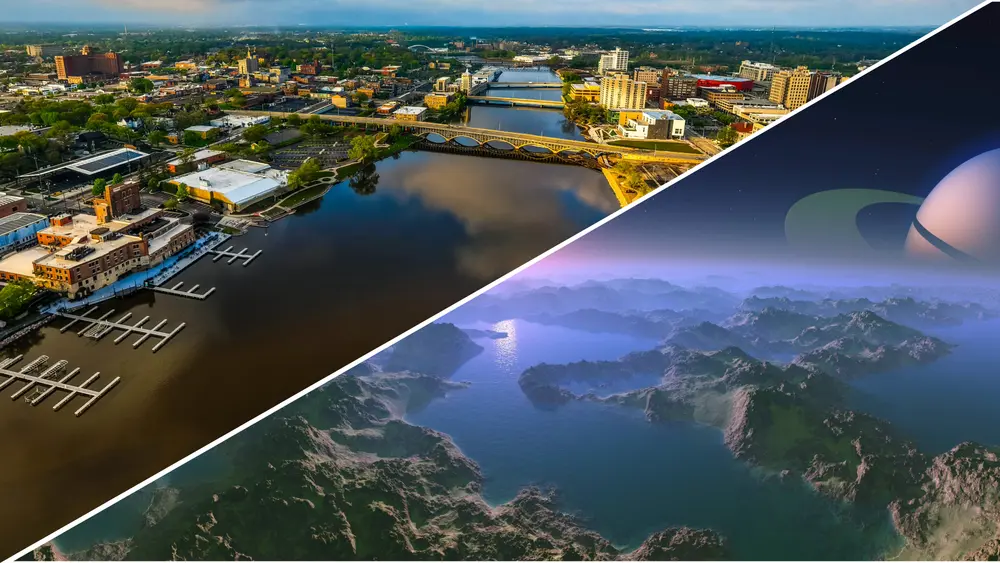
Taking apart a watch and reassembling it is one thing. Rebuilding an entire river landscape from scratch is another.
A collaboration among researchers across the United States and China is offering scientists a new way to understand how river landscapes form — not only on Earth, but also on worlds like Mars and Titan.
The study, published in the Proceedings of the National Academy of Sciences, presents a framework for “reverse engineering” river systems by rebuilding them from basic physical principles rather than simply observing their final forms through maps or satellite imagery.
“Instead of looking at a drainage basin formed by rain falling on land and analyzing what it shows, we’ve gone and disassembled it and reassembled it in a way that tells us how it functions,” said Earth Science & Environmental Change professor emeritus Gary Parker, one of the paper’s contributing authors.
The international team combined expertise in river networks, geomorphology, sediment transport, and landscape modeling to reconstruct three-dimensional river systems from branching channel networks, channel geometry, and hillslope formation. The resulting models can estimate elevation, river width, slope, sediment transport, and flood discharge throughout an entire watershed.
Understanding how landscapes function
The framework focuses not only on what landscapes look like, but why they take the forms they do.
“We can start answering those questions if we know something about how the drainage basin as a whole functions,” Parker said. “How all three of its parts — the tributary network, the channels themselves, and the hillslopes — interact together.”
That distinction could help researchers better understand how river systems respond to changing environmental conditions. The model allows scientists to test how landscapes might evolve under different precipitation levels, sediment sizes, or tectonic activity.
For example, increasing precipitation within a drainage basin would likely lower the landscape's overall relief while increasing river discharge. Researchers can also explore how earthquakes that suddenly introduce large amounts of sediment into river systems may alter landscapes over time.
“If we know not just what a drainage basin looks like, but how it functions, we can start to ask interesting questions,” Parker said.
Those questions range from erosion and sediment transport to fish habitat and watershed management. Understanding how water and sediment move through river networks could help researchers study how changing climates reshape landscapes and ecosystems.
From Earth to Titan
While the Earth-based applications are significant, one of the paper’s most intriguing aspects lies far beyond Earth itself.
The same framework can also be used to model river systems on Mars and Titan, Saturn’s largest moon.
Titan, in particular, has fascinated Parker for decades. Scientists now know the moon contains rivers, lakes, and rainfall, though unlike Earth, the liquid flowing across Titan’s surface is methane and ethane rather than water. The sediments are believed to consist largely of water ice.
“The conditions on Titan are not supportive of the kind of life that we understand,” Parker said. “But in terms of what the landscape looks like, it’s so different from yet remarkably similar to Earth.”
The new model allows researchers to adjust variables such as gravity, fluid viscosity, and sediment type to predict how landscapes might differ on other worlds.
A framework built over decades
Parker said the ideas behind the framework developed gradually over decades of studying rivers, sediment transport, and geomorphology. Many of the individual scientific pieces already existed, but bringing them together into a unified framework took years.
The collaboration accelerated after Parker shared an early version of the idea during his retirement seminar in 2022. Researchers working on complementary problems — including river network generation and geomorphology — continued building on the concept after meeting through conferences and existing academic partnerships.
Even after decades of studying rivers on Earth, Parker said the possibility of applying those same physical principles to alien worlds still captures his imagination.
“On Titan, we know that rivers are flowing today,” he said. “We know there are drainage networks. We know there are lakes. It’s a completely different environment, but the same physical principles ought to govern it.”