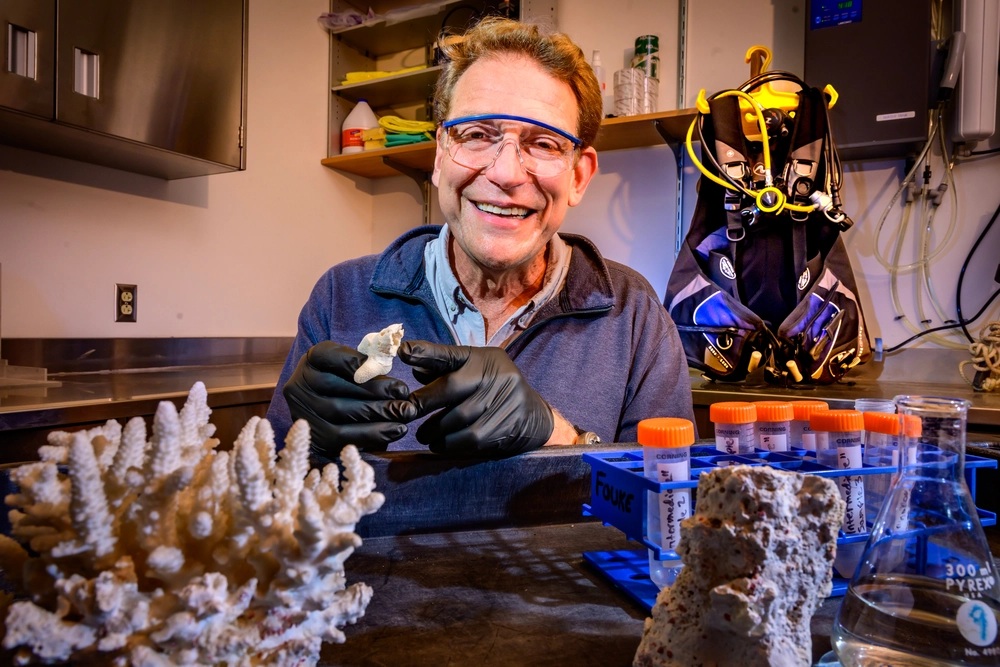
The Cancer Center at Illinois (CCIL) has more than 125 members from across the Illinois campus, including the Ralph E. Grim Professor in Earth Science & Environmental Change, Bruce Fouke . Given the great variety in backgrounds, research disciplines, and experiences of our members, we offer our Q&A series “Get to Know a Cancer Researcher” to provide readers with a connection with the amazing array of individuals who comprise the CCIL’s robust cancer research team. This is the seventh installment.
What originally drew you to cancer research?
My lab’s development of a GeoBioMed approach, which combines geology, biology, and medicine, has been underway for more than 40 years. GeoBioMed is rooted in an understanding that the human body is a microcosm of natural Earth mineralization processes that influence organ system etiology and pathology. This perspective has been central to Indigenous knowledge systems for millennia. In Western history, early conceptual foundations for understanding the human body in relation to natural processes can be traced to scholars such as Hippocrates, Leonardo da Vinci, Nicolaus Steno, and Alexander von Humboldt. However, it was not until the 1980s that the analytical tools required to mechanistically connect human health and nature began to emerge. GeoBioMed builds on these perspectives and their historical development by leveraging decades of research on calcification processes associated with the survival of highly diverse Bacteria, Archaea, and Eucarya through geological time. This continues to play out in my lab’s studies of coral reefs, hot springs, the deep subsurface, meteor impact craters, aqueducts, and other natural and engineered environments.