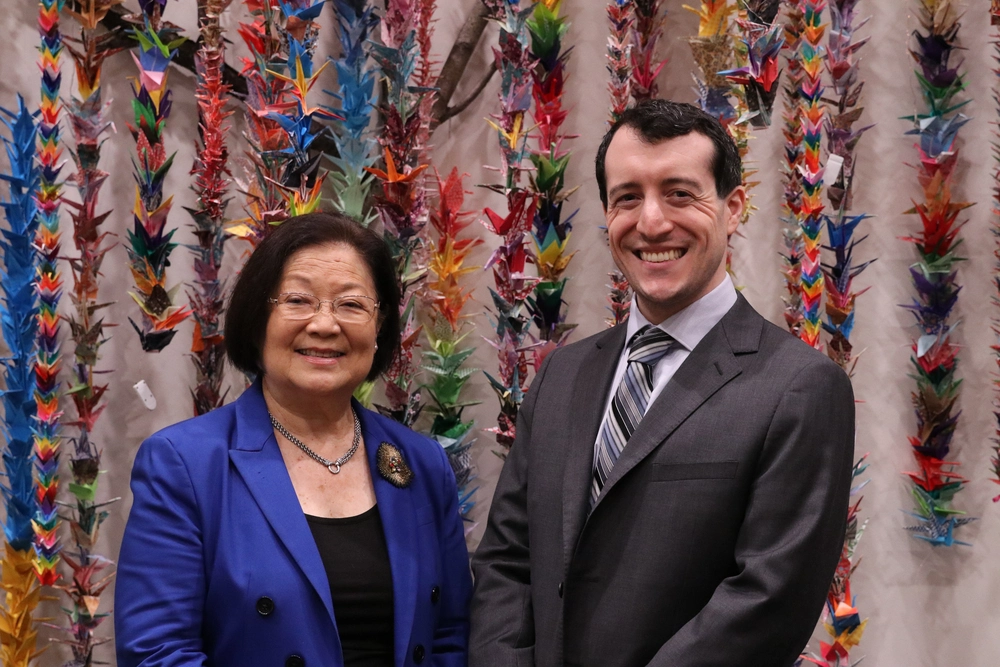
Long before he helped draft federal hazard mitigation legislation in the U.S. Senate, Robby Goldman (PhD, Geology, ‘23) was learning a different lesson as a graduate student: understanding complex problems starts with listening.
When Goldman arrived at Illinois in 2017 to pursue a PhD in the Department of Earth Science & Environmental Change, he planned to study volcanic systems through computational models and geodynamics under the supervision of professor Trish Gregg. Drawn by the department’s interdisciplinary culture, he expected to focus on combining geophysical data with geodynamical simulations to identify the forces that shape the location and timing of eruptions from Pacific Ocean island volcanoes.
Instead, a major eruption from Hawaii’s Kilauea volcano in 2018 pushed Goldman to ask a different question: once scientists understand a problem, how do they help people respond to it?
For Goldman, that question carried personal significance. Although he was raised in California, Goldman is Native Hawaiian and regularly visited his relatives in Honolulu growing up. The summer following his fifth-grade year, Goldman also attended a Hawaiian cultural immersion program at Kamehameha Schools, which deepened his appreciation for the overlap between Native Hawaiian knowledge and scientific research. These experiences helped shape Goldman’s interest in learning how scientific information helps communities prepare for, respond to, and recover from natural hazards, such as eruptions from Hawaii’s volcanoes.
Last year, Goldman completed a two-year Congressional Science Fellowship advising U.S. Senator Mazie Hirono of Hawaii on natural hazard mitigation and science policy. But he traces the foundation for that work back to experiences at Illinois that expanded his understanding of what scientists can contribute beyond research itself.
“One of the things that really stood out to me was the underutilized role of scientists in engaging communities with their science more broadly—not only in communicating the research that they do, but also the value that they bring to society,” Goldman said.
Finding a voice in science policy
That idea began to take shape during Goldman’s first semester, when he began attending workshops and seminars hosted by the campus Science Policy Group.
Until then, he said, policy had felt distant from day-to-day scientific work. Through the group, he was introduced to science communication, advocacy, and public engagement—and began to see policy not as a separate field but as another way science creates impact.
An early visit with then-Illinois State Senator Scott Bennett reinforced the idea that scientists could play a role in shaping public decisions.
Later that year, he traveled to Washington, D.C., for his first Geosciences Congressional Visits Day. The experience gave him an early look at how scientific expertise enters public service and showed him that scientists could play an active role in shaping decisions that affect communities.
The Science Policy Group also taught Goldman to translate technical ideas into accessible language and showed him that policy begins with communication and relationships.
“It gave me real-time training,” Goldman said. “It really prepared me to understand what makes conversations between scientists and their elected officials effective, and how those conversations are most effectively translated into meaningful policy.”
Building trust through research
One of the greatest lessons Goldman learned from his Native Hawaiian heritage is the concept of kuleana, which translates to one’s sense of responsibility and service to community. As his interests shifted toward hazard communication and public engagement, he began looking for ways to carry that responsibility into his scientific work.
“Growing up as a Native Hawaiian who's also been taught the methods and history of scientific research, I've come to recognize the importance of being able to bridge these two worlds of cultural knowledge and scientific knowledge,” Goldman said.
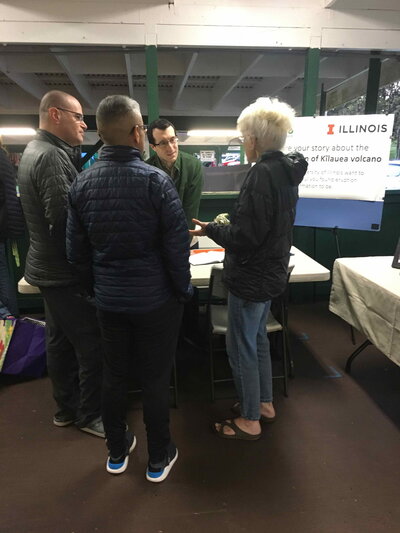
Goldman’s dissertation focused on hazard communication and trust during Hawaii’s 2018 Kilauea eruption, where he interviewed residents about how they received and acted on scientific information during the crisis.
What stood out to him wasn’t whether information existed. It was whom people trusted.
Residents with stronger relationships to scientific institutions—particularly the U.S. Geological Survey’s Hawaiian Volcano Observatory (HVO)--often felt more confident using hazard information provided by scientific sources. In contrast, others, particularly residents located tens to hundreds of miles away from HVO, turned first to local voices they trusted more.
Those conversations reshaped how Goldman thought about the role of scientists.
“It’s not enough just to communicate your research to other academics,” Goldman said. “It’s just as important to communicate your ideas to people who don’t do scientific research, in terms they can appreciate.”
The experience reinforced a lesson Goldman had begun learning at Illinois: solving problems requires more than producing good science. It requires understanding communities well enough to earn their trust.
The work also strengthened Goldman’s commitment to carrying that sense of responsibility into his future career.
“One of the things that became important for me as a goal to take away from my previous work was being able to meet that responsibility, or kuleana, of helping serve communities, particularly in Hawaii, if possible, during my fellowship.”
Carrying those lessons forward
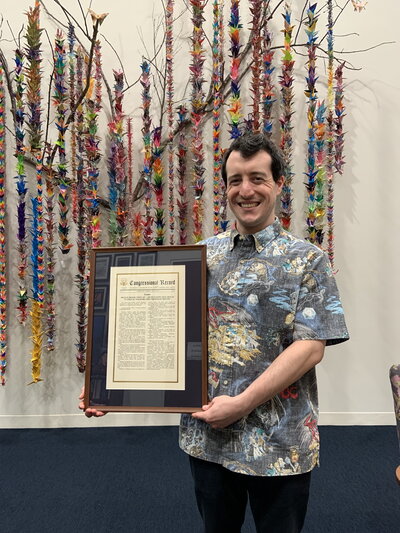
During his Congressional Science Fellowship in Senator Hirono’s office, Goldman supported initiatives related to wildfire resilience, volcano monitoring, and community preparedness. But while the setting changed—from field interviews and academic research to legislative meetings and stakeholder conversations, the approach remained familiar.
Whether meeting with researchers, agency staff, or community members, Goldman found himself returning to the lesson he had developed in graduate school: meaningful solutions begin with listening.
One of the most rewarding parts of the fellowship, he said, was helping ensure that constituents felt heard and that their experiences informed policymaking. During his time in Washington, Goldman also met with students and early-career scientists participating in advocacy programs—many of whom were in the same position he had once been in.
Now, as he continues his work in science policy and leadership within the geoscience community, Goldman hopes to help others see possibilities beyond traditional academic paths and encourage scientists to take those first steps into public engagement.
“There are many different avenues,” Goldman said. “It’s just a matter of finding those groups, finding those first steps.”